Annual Education Summit
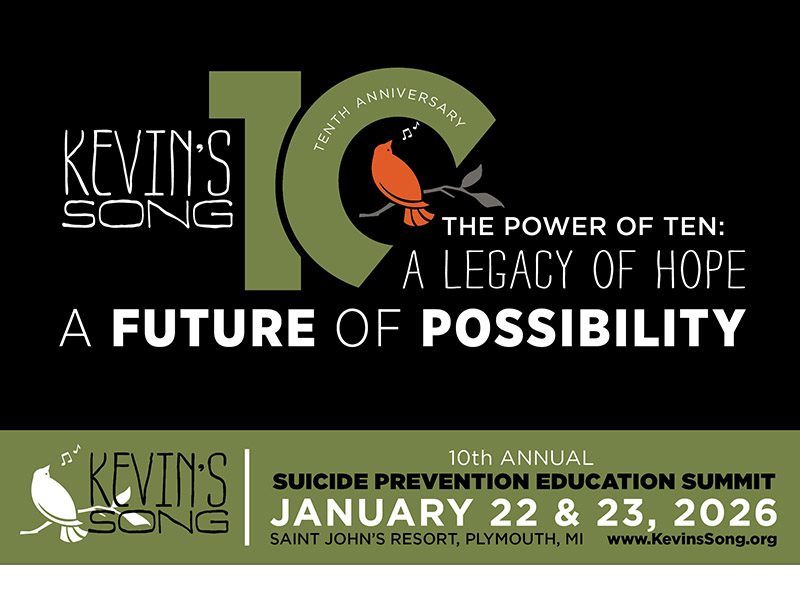
 Michigan’s largest and widely respected symposium directly focusing on suicide — the Kevin’s Song 10th Annual Suicide Prevention Education Summit, The Power of 10: A Legacy of Hope • A Future of Possibility, returns January 22 – 23, 2026 to the St. John’s Resort located at 44045 Five Mile Rd. in Plymouth, Michigan.This year, the Community Mental Health Association of Michigan (CMHA) is proud to join Kevin’s Song as a partner in the 2026 Kevin’s Song Education Summit.
Kevin’s Song and representatives from community mental health organizations around the state have worked together to offer a variety of sessions that will enable clinicians and mental health advocates to better serve communities and individuals in crisis and at risk for suicidal ideation. This is your chance to obtain valuable, evidence based strategies to address the increasing incidents of suicide and self-harm among African American youth, working aged men, veterans, seniors and the LGBTQ+ communities.
Drawing on its rich history of education about suicide and prevention, this 10th annual summit will offer a variety of keynote and breakout sessions providing many options to learn about evidenced-based prevention programs as well as practical and effective tools and treatments aimed at assisting at-risk individuals and communities. The summit will also provide support for survivors of suicide loss and those with a lived experience of suicide.
As we know, suicide is a leading cause of death in many age groups and within our own state, but we have not been making great strides in decreasing rates.The desire to provide more education to clinicians, suicide prevention advocates, teachers, and school counselors and to people directly impacted by suicide loss is why Kevin’s Song has taken a lead in Michigan for the past 10 years, with its annual educational summit to SAVE LIVES.
Thursday, January 22, 2026


The first day is the Youth Mental Health and School Summit, which will focus on integrating schools, together with youth-serving organizations and clinicians, to promote suicide prevention and mental well-being. Presentations will appeal to educators, mental health professionals and suicide prevention advocates who work with young people to build awareness and to share prevention strategies that are tailored to this diverse population. The Day will also include the stories of loss survivors and their journey through grief to hope.
SCHEDULE OF EVENTS:
7:30-8:00am REGISTRATION, RESOURCE GALLERY & COMPLIMENTARY BREAKFAST
8:00-8:15am WELCOME & INTRODUCTION – Jennifer Fair Margraf, MBA, CFRE, Executive Director
8:15-9:15am KEYNOTE 1: Youth Suicide Prevention: Promoting Healthy Social Connections and Support – Cheryl King, PhD, Professor Emerita, University of Michigan
VIEW/DOWNLOAD PRESENTATION SLIDES
This presentation will discuss youth suicide risk as an urgent public health and community concern. Because this risk presents in a myriad number of ways, it requires tailored and multi-faceted prevention strategies. Dr. King will provide an overview, based in scientific studies, of the importance of social connectedness and adult support to risk reduction, sharing national recommendations and promising intervention strategies in this area. These strategies focus on promoting healthy connections and building supportive adult networks for young people at risk. The presenter will discuss the implications of this knowledge for school, community, and hospital-based efforts to promote adolescent mental health and prevent self-harm and suicide.
9:15-9:30am BREAK
9:30-10:30am MORNING BREAKOUT SESSIONS:
- Affirming Lives: Suicide Prevention in LGBTQIA Youth and Communities – Carter Doyle, PMHNP-BC Nurse Practitioner, Leaf Psychiatry
Carter Doyle will review current statistics on suicide and suicide prevention in LGBTQIA communities. He will discuss current gaps in care and discuss ways to approach this population in the future. A focus will be on youths in the queer community with emphasis on strategies for parents and loved ones. - Social Media Addiction – Corey Hebner, BS, Community Service Trooper, Michigan
VIEW/DOWNLOAD PRESENTATION SLIDES
The workshop will discuss how addictive social media is. We will continue to compare social media usage to other forms of addictive behavior. The workshop discusses pitfalls of over usage of social media, monetary issues associated with our cell phones and kids gaming systems, and then we will discuss strategies for reduction in usage for parents and children.
- When Words Aren’t Enough: Supporting Families Through Adolescent Suicide Risk – Fritz and Josephine Klingler, Suicide Loss Survivor with Gigi Colombini, LMSW, Psychotherapist – Suicidologist, Institute for Hope & Human Flourishing
This presentation shares the deeply personal journey of two parents who lost their teenage son to suicide after days of searching for answers, resources, and hope. With honesty and courage, they recount their desperate efforts to recognize the warning signs, navigate a complex and often confusing mental-health system, and advocate tirelessly for the support their son needed. Through their story, they illuminate the struggles many families face -misunderstood symptoms, long waits for care, limited access to specialists, and the overwhelming fear of not knowing how to help a child in pain. Their presentation aims to break silence and stigma, encourage earlier conversations about emotional well-being, and offer insight into how caregivers, schools, and communities can better support vulnerable teens. It is a tribute to their son’s life, a reminder of the challenges too many families encounter, and a call to create a world where every young person can find help before it is too late.
- Bridging the Gap: Connecting Inpatient Psychiatry and Schools to Support Youth Recovery – Abishek Bala, MD MPH, Physician, Central Michigan University
This workshop explores how educators, mental health professionals, and community partners can collaborate to support adolescents following psychiatric hospitalization. Drawing from real-world experiences in inpatient child and adolescent psychiatry, Dr. Abishek Bala will describe what inpatient care entails, including admission criteria, the therapeutic process, and discharge planning. The session will highlight common challenges during the transition back to the community and examine both the challenges and opportunities to improve communication, continuity of care, and shared responsibility between hospitals, families, and schools. Participants will reflect on how school reintegration can serve as an opportunity for recovery and resilience rather than a point of vulnerability. The session concludes with an interactive discussion aimed at strengthening systems of coordination and bridging gaps across sectors. - How Employers Can Support Their Employees & Unlock the Mystery of Human Behavior – Kent Sharkey, LMSW, President and CEO, Ulliance, Inc.
The presentation explains how human behavior is shaped by the interaction between the rational mind and the emotional mind, emphasizing that emotions can often override logic and influence decision-making. It highlights the growing prevalence of stress, anxiety, and depression in the workforce, driven by overstimulation, lack of boundaries, and constant uncertainty. The session explores the biology of emotions—how neurons, memories, and neurotransmitters shape our perceptions and reactions—and why emotional regulation is often challenging. It provides strategies such as cognitive restructuring, mindfulness, diaphragmatic breathing, and reframing thoughts to help individuals reduce anxiety and prevent emotional hijacking. The presentation also discusses the strong connection between mental and physical health, noting that chronic stress contributes to many illnesses. Finally, it outlines the comprehensive support available next through robust, next generation, comprehensive Employee Assistance Program (EAP), including counseling, coaching, crisis services, and resources to help employees manage personal and work-life challenges.
10:30-10:45am BREAK
10:45-11:45am KEYNOTE 2: Strengthening Protective Environments: Culturally Responsive Approaches to Suicide Prevention – Roddia Hill, PsyD, Clinical Director, Suicide Prevention and Risk Management, TRAILS
VIEW/DOWNLOAD PRESENTATION SLIDES
Suicide prevention must move beyond one-size-fits-all approaches to truly meet the needs of youth disproportionately impacted by suicide risk. This session will explore how culturally responsive strategies can strengthen protective environments across schools, communities, and behavioral health settings. Participants will examine how cultural identity, trauma, and barriers to support shape suicide risk and access to care. Grounded in cultural humility, the session will highlight practical, hands-on tools to adapt prevention, intervention, and postvention practices. Attendees will leave with concrete strategies for building authentic connections, reducing stigma, and co-creating safe, responsive environments with the youth and families they serve.
11:45am-1:00pm LUNCH
12:30-1:00pm LUNCHEON SPEAKERS: Collaborative Strategies for Suicide Prevention in Michigan – Lindsay DeCamp, MHA, State Suicide Prevention Coordinator, Michigan Department of Health and Human Services, and Kasie Kaufman, MPH, PMP, Executive Director; Board Chair
VIEW/DOWNLOAD PRESENTATION SLIDES
This presentation will provide an overview of two federally funded Michigan Department of Health and Human Services programs, Transforming Youth Suicide Prevention in Michigan (TYSP) and Preventing Suicide in Michigan Men (PRiSMM), and the statewide organization With One Voice (WOV). Attendees will gain insight into how these programs and WOV align with the goals and strategies outlined in the Michigan Suicide Prevention Plan 2024–2027 by supporting youth, adult men, and community coalitions through evidence-based practices, culturally responsive approaches, and cross-sector collaboration. The session will highlight how these efforts collectively strengthen Michigan’s capacity to prevent suicide and promote mental wellness across the lifespan.
1:00-1:15pm BREAK
1:15-2:15pm KEYNOTE 3: Wired to Feel: Understanding Adolescent Brain Development and Suicidal Risk – Jaime Taylor, DO, MS, FAAFP, Founder and Medical Director
VIEW/DOWNLOAD PRESENTATION SLIDES
Adolescence represents a critical window of neurobiological, psychological, and social transformation. During this period, the brain is “wired to feel”, with emotional centers developing faster than the regions responsible for regulation and judgment. This imbalance contributes to impulsivity, emotional reactivity, and vulnerability to stress, particularly within a culture that promotes instant gratification and constant comparison. This lecture explores how developmental changes intersect with the rising prevalence of non-suicidal self-injury (NSSI) and suicidal ideation (SI), highlights the impact of social media and environmental factors, and provides practical tools for promoting resilience, emotional regulation, and healthy brain development in youth.
2:15-2:30pm BREAK
2:30-3:30pm AFTERNOON BREAKOUT SESSIONS:
- Hungry Minds: The Overlooked Link Between Food, Feelings, and Healing – Jaime Taylor, DO, MS, FAAFP, Founder and Medical Director, and Devyn Goodman, MS, RDN, Director of Nutrition, rethink.
This workshop explores how nutrition directly influences brain function, mood regulation, and the effectiveness of mental health treatment. This session challenges diet culture by embracing the “all foods fit” philosophy, emphasizing that flexibility and balance, not restriction, support both physical and emotional well-being. Participants will learn how consistent nourishment fuels the brain and body, helping to stabilize energy, improve focus, and enhance resilience. We’ll discuss how nutritional adequacy plays a vital role in managing anxiety, depression, and recovery from eating disorders. Attendees will leave with practical strategies to support mental health through compassionate, sustainable eating habits that honor both body and mind. - Holding Onto Life Toolkit Tips for Professionals and Parents on How to Support an Adolescent after a Suicide Attempt – Nancy Buyle, MA, LPC, ACTP, School Safety/Student Assistance, Consultant/Psychotherapist, Macomb Intermediate School District, Gigi Colombini, MSW, Clinical Social Worker, Institute for Hope and Healing, and Alejandra Arango, PhD, Clinical Assistant Professor, University of Michigan and Syma Khan, MSW, MPH , Clinical Social Worker, University of Michigan
Supporting a youth struggling with suicide can feel overwhelming for both families and professionals. The Holding Onto Life Toolkit was developed to provide practical guidance, compassionate strategies, and reliable information to help parents, caregivers, and school staff navigate this critical time. In this session, participants will be introduced to the updated toolkit and learn how to use it as a resource for promoting safety, healing, and hope. Presenters will share real-world applications, communication strategies, and collaboration tips that strengthen the circle of support around a young person experiencing a suicidal crisis. Attendees will leave with actionable tools and insights to foster connection, reduce stigma, and build resilience in both youth and their support systems. - Practicing Cultural Responsivity: Tools to Support Youth in Crisis – Roddia Hill, PsyD, Clinical Director, Suicide Prevention and Risk Management, TRAILS and Ben Karle, LMSW, Behavioral Health Program Coordinator, St. Joseph County ISD
Building on the foundation of the main session, Practicing Cultural Responsivity: Tools to Support Youth in Crisis, this session offers participants an interactive space to apply culturally responsive strategies in real-world contexts. Through scenario-based activities, small, and large group discussions, and guided reflection, attendees will explore how culture, identity, and barriers to support shape youth experiences during moments of crisis. This session emphasizes using a culturally responsive lens to assess suicide risk, respond with sensitivity and equity, and adapt existing prevention and intervention practices to meet the unique needs of diverse youth. - The Effect of Adolescent Drug Use on Mental Health and Suicidology, as well as Consequences of Consuming Substances with High THC Content – Bruce Goldberg, LMSW, ACSW, CAADC, SAP, President, River’s Bend PC
VIEW/DOWNLOAD PRESENTATION SLIDES
Adolescent drug use has a profound impact on mental health, often increasing the risk of depression, anxiety, and suicidal thoughts or behaviors. During adolescence, the brain is still developing—particularly areas responsible for decision-making and emotional regulation—making teens more vulnerable to the harmful effects of substances. High-THC cannabis products, now more potent than in previous decades, can significantly disrupt brain chemistry, leading to cognitive impairment, paranoia, and psychotic symptoms in some individuals. Regular use of high-THC substances is linked to increased rates of mood disorders and suicidal ideation. Substance use can also worsen existing mental health conditions and reduce the effectiveness of treatment interventions. Over time, these combined effects can contribute to social isolation, academic decline, and a higher likelihood of self-harm or suicide attempts among adolescents.
- Bridging Campus and Community: Advancing Mental Health Access through Michigan Community Colleges –Tim Rhodes, MSW, MPH, Research Staff, Mental Health Improvement through Community College (MHICC) Initiative and Shawna N. Smith, PhD, Co-Director & Principal Investigator, Mental Health Improvement through Community Colleges (MHICC) Initiative
VIEW/DOWNLOAD PRESENTATION SLIDES
This session will spotlight the pivotal role that community colleges play in connecting students to evidence based mental health care and supporting the well-being of the broader community. Tim Rhodes, MSW, MPH, and Shawna Smith, PhD, will share their work from the Mental Health Improvement through Community Colleges (MHICC) initiative to highlight current trends in community college student mental health needs and the landscape of mental health services available across Michigan’s 31 community and tribal colleges. The presenters will underscore innovative strategies for expanding community college students’ access to mental health care, while discussing the role that community organizations and K-12 institutions play in supporting the mental health needs of this population.
- EAPs as Lifelines: Reducing Trauma and Suicide Risk for Healthcare Employees – Christine Hilton, LMSW, Integrated Mental Health Project Manager/EAP Therapist, Henry Ford Health Enhance Employee Assistance Program, and Kent Sharkey, LMSW, President and CEO, Ulliance, Inc.
This presentation offered in a panel discussion will review wellbeing strategy and initiative of a large health organization (Henry Ford Health). The evidenced based programs in place support the emotional well-being of employees, mitigate the effects of trauma, and reduce suicide risk. Henry Ford Health believes in supporting their employees with a Real Time Helpline available 24/7, short term counseling with employees trained in crisis response, post crisis response team to provide critical incident stress debriefing of departments in need, TRUST program, Stronger Together Buddy Program, Spiritual Care support, and Mental Health First Aid trainings. Additionally, this health care system has higher levels of behavioral health and substance use disorder care available (such as inpatient, Intensive Outpatient, and Partial Hospitalization Program) for employees who may need something more intensive than outpatient care. This is yet another way to decrease risk for suicide. As we enter 2026 the goal is to continue to grow these programs.
3:30-3:45pm BREAK
3:45-4:45pm KEYNOTE 4: Best Practices for Suicide Postvention in Schools: Managing Dilemmas and Changing the Narrative – Larry Berkowitz, Ed.D., Co-Founder, Senior Clinical Consultant, Riverside Trauma Center, a Service of Riverside Community Care
VIEW/DOWNLOAD PRESENTATION SLIDES
Sadly, it is increasingly likely that schools will be impacted by the suicide death of a student. This presentation will provide information for school-based teams to respond to the tragedy of suicide loss by learning effective, best practice strategies to support students, faculty, staff and families after a suicide death. Content includes tasks for conducting postvention activities, use of screening tools in a postvention setting, and strategies for responding to typical dilemmas such as handling memorials, responding to denial that the death was a suicide and reacting to information spread on social media. The presentation shares qualitative data from interviews with young adults who were students in schools where they experienced the suicide death of a student in their middle or high school.
5:00-6:30pm COMPLIMENTARY RECEPTION
6:30-8:00pm DINNER Honoring Thomas Joiner, PhD. Join the Kevin’s Song family, joined by Bart Andrews, PhD and Michael Anestis, PhD, for this tribute to Dr. Thomas Joiner and his landmark contributions to suicide research and prevention. Entertainment provided by UM Musical Theater students. (separate ticket event)
Friday, January 23, 2026


The program for the second day will include an array of powerful presentations that engage clinicians and suicide prevention advocates to enhance their knowledge and skills to prevent suicide. Attendees will hear the latest in research about suicide and risk assessment as well as evidenced-based treatments and prevention strategies to better serve individuals and communities at risk. The program will also include the stories of loss and attempt survivors and their journeys through grief to hope.
SCHEDULE OF EVENTS:
7:30-8:00am REGISTRATION, RESOURCE GALLERY & COMPLIMENTARY BREAKFAST
8:00-8:15am WELCOME & INTRODUCTION – Jennifer Fair Margraf, MBA, CFRE, Executive Director
8:15-9:15am KEYNOTE 1: Overview of Extreme Risk Protection Orders in Michigan and the Relevant Research – April Zeoli, PhD, MPH, Associate Professor, University of Michigan
VIEW/DOWNLOAD PRESENTATION SLIDES
Zeoli will provide a brief overview of Michigan’s extreme risk protection order (ERPO) law, often called a red flag law, and its use in Michigan, specifying who can file a petition and how it is filed. She will also share research findings on ERPO, including how it’s used in other states, who the respondents to the order are, and outcomes of the orders.
9:15-9:30am BREAK
9:30-10:30am MORNING BREAKOUT SESSIONS:
- Building Safety Through Empathy: The Counselor’s Role in Safety Planning Through a Rogerian Lense – Maggie Sweeney, PLC, Private Practice Counselor and Suicide Prevention Consultant, Mind Body Solutions LLC and Hope Network
This presentation will explore how the six core factors of Rogerian therapy—congruence, unconditional positive regard, empathetic understanding, openness, genuineness, and acceptance—can be integrated into the process of safety planning with clients who are struggling with suicidal thoughts and desires. Emphasizing the counselor’s active participation, we will discuss how these factors create a collaborative, supportive environment that fosters trust and promotes meaningful engagement. Rather than seeing safety planning as a mere checklist or liability reducing paperwork, we will highlight how it can be a dynamic, client-centered process that prioritizes emotional connection and the client’s unique needs. Attendees will gain insight into how the counselor’s authentic presence and empathetic understanding can empower clients to participate in their own safety planning, ultimately increasing the likelihood of long-term success. The session will also address practical strategies for counselors to apply these principles in real-time during safety planning conversations, with an emphasis on enhancing client autonomy and ensuring the plan is both realistic and empowering.
- Beyond “Denies SI/HI:” Conducting and Utilizing Risk Assessments to Improve Patient Care – Layla Soliman, MD, Assistant Professor of Psychiatry, Atrium Health/Wake Forest University School of Medicine – Charlotte Region
VIEW/DOWNLOAD PRESENTATION SLIDES
This session will focus on the purpose of risk assessments, approaches to conducting risk assessments, and approaches to documentation. We will also discuss some clinical strategies for navigating high risk situations. These include managing countertransference, sensitive gathering of collateral data, and working within the limits of local resources.
- Aging, Dementia, and Suicide Risk: Protecting Senior Mental Health & Wellness – Doree Ann Espiritu, MD, Director, Behavioral Health Integration with Primary Care, Henry Ford HealthThe presentation will address how aging and dementia increase the risk for suicide especially with psychiatric comorbidities. Furthermore, it will also go over the protective factors and the interventions needed in order to prevent suicide and promote wellness in the older adult population.
- Extreme Risk Protection Order (ERPO) – Richard C. Fuller III, BS, Sheriff, Kalamazoo County Sheriff’s Office, Danielle Hagaman-Clark Criminal Bureau Chief of the Michigan Department of Attorney General, and Jessica Roche, Managing Director of the University of Michigan Institute for Firearm Injury Prevention
This session will examine the implementation of Extreme Risk Protection Orders (ERPO) in Michigan. Participants will explore the challenges, successes, and lessons learned from Michigan’s experience with ERPOs to date. The session will also feature diverse perspectives from law enforcement, attorneys, and community advocates on the ERPO process, examining areas for improvement and how the implementation of this important law can continue to evolve for greater effectiveness in preventing gun violence. - Grieving Out Loud – Heather Williams, MA, LPC, Founder, Southern Wellness Co.
In this powerful presentation, a suicide loss survivor shares her personal journey of navigating profound grief and loss. Through storytelling, she will reflect on the early challenges of bereavement and illustrate how “grieving out loud” became a meaningful coping strategy and pathway toward healing. The session will explore how open expressions of grief fostered connection, community, and a continuing bond with her loved one. Attendees – including clinicians, caregivers, and community members – will gain deeper insight into the lived experience of suicide loss and learn ways to offer compassionate, informed support to survivors.
10:30-10:45am BREAK
10:45-11:45am KEYNOTE 2: New Generation Treatments to Prevent Suicide – Craig Bryan, PsyD, ABPP, Professor & Director of the Suicide Care Clinic, University of Vermont Larner College of Medicine
The United States’ suicide rate has increased steadily since 1999, despite expanded efforts to identify at-risk individuals and connect them with mental health treatments and interventions, prompting researchers to develop, test, and refine new treatment methods. In contrast to traditional approaches that view suicide risk as a symptom or outcome of psychiatric disorders, newer generation treatments view suicidal behavior as a transdiagnostic behavior that results from distinct mechanisms and processes. This approach has significantly improved the effectiveness of newer generation treatments relative to typical mental health treatments. Two interventions in particular, brief cognitive behavioral therapy for suicide prevention (BCBT) and crisis response planning (CRP), have been shown to reliably reduce suicidal behaviors in multiple randomized clinical trials. This presentation provides an overview of these interventions.
11:45am-1:00pm LUNCH
12:30-1:00pm LUNCHEON SPEAKERS: State of Community Mental Health in Michigan – Dana Lasenby, Chief Executive Director, Oakland Community Health Network, Traci Smith, Chief Executive Officer, Macomb County Community Mental Health, and James E. White, President and CEO, Detroit Wayne Integrated Health Network
1:00-1:15pm BREAK
1:15-2:15pm KEYNOTE 3: The Path Beyond the Crisis: Finding Possibilities for Growth –DeQuincy Lezine, PhD, Director, Lived Experience Academy
VIEW/DOWNLOAD PRESENTATION SLIDES
How do we build on crisis stabilization to create futures with positive potential? This session explores what can come after successful prevention of suicidal behavior: a path to recovery, resilience, and growth. The presentation introduces the concept of Post-Suicidal Growth (PSG), a path for achieving it, and the lessons from the decades of research on Post-Traumatic Growth (PTG). Drawing on lived experience, research, and clinical insight, this session examines how individuals with lived experience (from their own experiences or from friends and family) can pursue meaningful life changes after crisis resolution.
2:15-2:30pm BREAK
2:30-3:30pm AFTERNOON BREAKOUT SESSIONS:
- AI and Suicide Prevention: Opportunity and Challenges – Rajiv Tandon, MD., Professor of Psychiatry, Western Michigan University Homer Stryker School of Medicine
In the context of the enormous public health problem of suicide, current clinical approaches are proving inadequate. There are limitations in our ability to both identify individuals at times of high risk and provide timely and specific interventions to mitigate that risk. With the increasing power of various tools of artificial intelligence (AI) and their application to a range of health another social problems, there is great interest in its potential to meet these challenges. To address the need for better identification of individuals at times of heightened suicide risk, a number of AI methods have been developed- these include several machine learning algorithms, timely contemporaneous analysis of individual social media posts and wearable devices, and efficient review of electronic health records. To provide specific intervention in a timely manner, real-time clinical alerts and provision of personalized supports along with virtual therapists (chatbots and virtual reality therapy) have been developed. In this presentation, the nature and current status of each of these methods will be reviewed and their potential for clinical use will be discussed. Ethical challenges and limitations of current AI approaches to suicide prevention will be summarized. - Culturally Tailored Approaches to Suicide Prevention in Rural Communities – Cynthia Ewell-Foster, Clinical Professor, The University of Michigan and Sarah Derwin BA, Health Educator, Marquette County Health Department
Across the US, age-adjusted suicide rates in rural counties are more than two times higher those in urban counties, with these disparities driven by firearm-related suicides. This session will explore unique considerations for the prevention of suicide in rural areas, including the critical role of community partnerships to ensure that messages are culturally tailored, acceptable to the community, and reflect the strengths and protective factors in rural areas. The session will share lessons learned from the implementation of a comprehensive public health approach to suicide in Michigan’s Upper Peninsula (UP). The importance of credible messengers in promoting firearm safety and lethal means counseling will be discussed, along with cultural factors that influence firearm ownership and storage practices in rural communities. Attendees will be introduced to Store Safely, a new multi-component online primary prevention strategy currently being implemented and evaluated in Michigan’s UP. - Preparing the Pathway to Healing for the Bereaved and the Professional – Gwen Kopcia, CT, LBSW, Owner, Your Grief Guide
With the pain and suffering surrounding suicide loss, we want to be sure we are preparing a pathway for healing. Many times, we feel uncertain on what to say or do when being present to the hurting survivors. It is critical that our responses are helpful and not hurtful. This workshop will look closer into what the bereaved person needs, provide techniques for the worker to assure we are not revictimizing the hurting, and that we remain healthy in this process. - Integrating Zero Suicide in Certified Community Behavioral Health Clinics (CCBHCs) – Laurin Jozlin,LMSW, Senior Project Associate, EDC
This presentation explores practical strategies for implementing the Zero Suicide framework within Certified Community Behavioral Health Clinics (CCBHCs) to create a comprehensive, system-wide approach to improving suicide care. Participants will learn how CCBHCs can embed evidence-based practices, strengthen leadership commitment, and develop coordinated suicide care pathways that ensure no one falls through the cracks. Through examples and implementation lessons, the session highlights tools, training, and metrics that drive sustainable change—empowering outpatient settings to move from crisis response to proactive prevention and continuous improvement. - Lethal Means Safety Counseling for Community Members – Jeremy Suttles, LMSW, MSE, Community Engagement and Partnership Coordinator, Veterans Administration Ann Arbor Healthcare System
VIEW/DOWNLOAD PRESENTATION SLIDES
This workshop will introduce Lethal Means Safety as an intervention to help reduce overdose and suicide deaths. Participants will learn what lethal means are, the connection between lethal means and risk of harm, and tips for engaging in conversations around lethal means safety. Specific attention is given to the importance of understanding culture and values as part of the counseling and planning process. Additional resources will be shared as well.
- Applying Dynamical Systems Approaches to Identify Short-Term Risk for Suicidal Behavior –Melanie Bozzay, PhD, Suicide Prevention Director, Assistant Professor, The Ohio State University Department of Psychiatry, Affiliated Assistant Professor (Research), Brown University
Suicide is a significant public health problem. Currently, there are no clinical strategies available to identify who will engage in suicidal behavior and when, hindering efforts to deliver targeted, timely interventions to prevent suicides. In recent decades, computationally intensive models have been developed to forecast which patients are at risk of suicidal behavior, months to years in advance. Despite these advances, existing risk monitoring systems do not reduce suicidal behavior or identify clinically actionable time periods of risk. This talk will describe the current state of suicide risk prediction science and ethical considerations of prediction approaches. It will then describe a novel strategy towards predicting suicidal behavior days in advance informed by dynamical systems theory, currently in development in the Analysis to Reveal Trajectories and Early Markers of Imminent Shifts in Suicidal States (ARTEMIS) Study.
3:30-3:45pm BREAK
3:34-4:45pm KEYNOTE 4: Discussion of the Progress in Suicide Research and Prevention: What’s on the Horizon – Thomas Joiner, PhD, Professor, Florida State University
This session aims to provide an in-depth exploration of the evolving landscape of suicide research, focusing on three critical areas: the future directions of research in suicide risk prediction, the progression from suicidal ideation to action, and the psychological pain associated with suicidal crises. By connecting these three vital areas, this session will not only highlight the critical gaps in current research but also inspire collaborative efforts towards developing effective prevention strategies. Participants will leave with a renewed understanding of the complexities of suicide risk and actionable insights to inform their work in this essential field. This presentation promises to be a thought-provoking and informative session, encouraging active engagement and dialogue among researchers, clinicians, and advocates committed to reducing suicide rates and improving mental health outcomes.
Who’s Invited
Participants in the 10th Annual Kevin’s Song Suicide Prevention Education Summit will gather in-person from all around the State of Michigan – from Metro Detroit to Marquette and from Grand Rapids to Bay City.
Participants Will Include:
- Educators / Teachers
- Parents / Family Members
- Psychologists /Social Workers / Licensed Counselors
- Physicians / Nurses / Medical Professionals
- Crisis Center Workers
- First Responders / Law Enforcement and Firefighters
- Policymakers
- Loss Survivors
- Employers/Human Resource Professionals
- Veterans and Veteran Support Groups
- People with Lived Experience
- Members of the General Public
- Professional Trainees and Students
The first day is the Youth Mental Health and School Summit, which will focus on integrating schools, together with youth-serving organizations and clinicians, to promote suicide prevention and mental well-being. Presentations will appeal to educators, mental health professionals and suicide prevention advocates who work with young people to build awareness and to share prevention strategies that are tailored to this diverse population. The Day will also include the stories of loss survivors and their journey through grief to hope.
The program for the second day will include an array of powerful presentations that engage clinicians and suicide prevention advocates to enhance their knowledge and skills to prevent suicide. Attendees will hear the latest in research about suicide and risk assessment as well as evidenced-based treatments and prevention strategies to better serve individuals and communities at risk. The program will also include the stories of loss and attempt survivors and their journeys through grief to hope.
Throughout the education summit, attendees may visit the Memorial Forest – a quiet place dedicated to those whose lives were prematurely ended. It is a place of solace, in the middle of a busy conference center, filled with lighted trees adorned with the names of those loss and those honored. Attendees are invited to remember their loved ones with a personalized ornament.
Registration Information:
Early Bird Price: $375 (through 1/6/2026)
Regular Price: $500 (on or after 1/6/2026)
This 2-Day Registration: THURSDAY: Youth Mental Health & School Summit AND FRIDAY: Suicide Prevention Education Summit – provides you with a program bag and conference packet, admission to all keynote presentations and breakout sessions, breakfast and lunch each day and complimentary Thursday Afternoon Reception.
Early Bird Price: $225 (through 1/6/2026)
Regular Price: $275 (on or after 1/6/2026)
Registration for the THURSDAY: Youth Mental Health and School Summit provides you with a program bag and conference packet, admission to all keynote presentations and breakout sessions. Includes breakfast, lunch and beverages. Also includes complimentary Thursday afternoon Reception.
Early Bird Price: $200 (through 1/6/2026)
Regular Price: $250 (on or after 1/6/2026)
Registration for the FRIDAY: Suicide Prevention Education Summit provides you with a program bag and conference packet, admission to all keynote presentations and breakout sessions. Includes breakfast, lunch and beverages.
Student ID Must be Presented at Check-In.
Early Bird Price: $140 (through 1/6/2026)
Regular Price: $140 (on or after 1/6/2026)
This 2-Day Student Registration: THURSDAY: Youth Mental Health & School Summit AND FRIDAY: Suicide Prevention Education Summit – provides you with a program bag and conference packet, admission to all keynote presentations and breakout sessions, breakfast and lunch each day and complimentary Thursday Afternoon Reception.
Student ID Must be Presented at Check-In.
Early Bird Price: $75 (through 1/6/2026)
Regular Price: $75 (on or after 1/6/2026)
Student Registration for the THURSDAY: Youth Mental Health and School Summit provides you with a program bag and conference packet, admission to all keynote presentations and breakout sessions. Includes breakfast, lunch and beverages. Also includes complimentary Thursday afternoon Reception.
Student ID Must be Presented at Check-In.
Early Bird Price: $70 (through 1/6/2026)
Regular Price: $70 (on or after 1/6/2026)
Registration for the FRIDAY: Suicide Prevention Education Summit provides you with a program bag and conference packet, admission to all keynote presentations and breakout sessions. Includes breakfast, lunch and beverages.
January 22, 2026 – 6:30- 8:30 pm
$40 Requires Separate Ticket
A limited number of scholarships are available to individuals with a financial hardship. Conference scholarships will cover conference registration fees only.
Deadline to request scholarship: Friday, January 16, 2026
The scholarship application form is below. Contact Susan Francis at sumfrancis1@gmail.com if you have any questions.
Kevin’s Song has reserved a block of rooms at SAINT JOHN’S RESORT HOTEL – 44045 Five Mile Road, Plymouth, Michigan 48170. For reservations call 734-414-0600 and mention “Kevin’s Song Foundation” to receive special nightly rate of $179, plus applicable fees and taxes. GROUP CODE: KE012026A
For the Kevins Song Group online reservation website: CLICK HERE:
Continuing Education Information Coming Soon
Cancellation Policy:
- Fees for registration if applicable must be paid in full prior to the event date.
- Substitutions are encouraged and preferred.
- No refunds will be issued for cancellations received less than 10 calendar days prior to the event start date and all unpaid invoices will be due in full.
- No refunds will be issued for no-shows and all unpaid invoices will be due in full.
- Cancellations will only be considered when received in writing. Telephone requests will not be honored.
- Please email your cancellation requests to: Leo@kevinssong.org
Questions about Registration or Continuing Education?
General Questions about the conference, the program, or the training opportunities? Email Leo@kevinssong.org